Minecraft Factions is the most complete and demanding mode in all of Minecraft multiplayer. Strategy, economy, PvP, defensive building, diplomacy: it all happens simultaneously.
👉 The good news: no one is born with the reflexes of a Factions player. Everything can be learned, and this guide gives you all the basics so you don't start from scratch.
➡️ Find the Factions server suited to your level on McServ.org.
Understanding the Fundamental Mechanics
Claims and Power
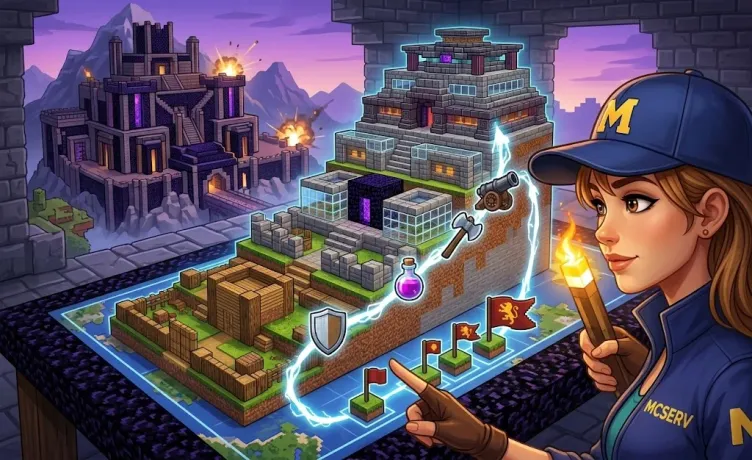
The claims system is the heart of Factions. Each chunk (area of 16x16 blocks) can be claimed by a faction. In a claimed chunk, enemy members cannot break blocks normally: they must use TNT cannons to break in.
👉 But here’s the mechanic that many beginners overlook: power. Each player has an individual power gauge. This power contributes to the faction's total pool. If you die, you temporarily lose power. If your faction's total power drops below the number of claimed chunks, your territories become vulnerable to overclaiming, a technique where enemies can take your chunks without a cannon.
- Max power per player: usually between 10 and 20 depending on the server
- Power lost per death: usually 4 to 8 depending on the server
- Recovery: power regenerates over time when you are online
Faction Members and Roles
- Leader: founder of the faction, has full rights over all decisions
- Co-leader: nearly full rights, manages daily operations
- Officer: can invite, kick, and manage certain land permissions
- Member: standard member, can use common resources according to set permissions
- Recruit: new member, limited rights until trust is earned
The Factions Economy
Most servers have an in-game economy. You earn money by farming items like sugar cane or by killing mobs that come from spawners, then you use that money to buy better equipment, more spawners, or base defenses.
The main sources of income:
- Spawners: generate mobs that drop sellable items. This is the backbone of the Factions economy on most servers.
- Automatic farms: sugar cane, wheat, cactus. Passive production that accumulates while you are away.
- PvP drops: items you collect from players you eliminate.
- Successful raids: stealing spawners and treasure from an enemy base can earn you weeks of farming in a single session.
The First Hours: What to Do at the Start of a Season
Joining at the Start of the Season
Timing is crucial in Factions. New maps offer a fair start for beginners, while already established maps are better suited for experienced raiders. If possible, join at the very beginning of the season to have the same chances as everyone else.
The First 30 Minutes: The Race for Resources
As soon as you spawn, you have a clear objective: gather basic resources as quickly as possible.
- Use /wild or /rtp: most Factions servers have a random teleport command. Use it to get away from spawn and the initial combat zone.
- Immediately build a temporary shelter: even a dirt block is enough to protect you from hostile players in the first few minutes.
- Farm wood, stone, iron: the basic resources to craft your first equipment.
- Avoid combat in the first hours: dying early makes you lose power and your accumulated resources.
Create or Join a Faction
👉 For beginners, joining an existing faction is always recommended rather than creating one alone.
Join an existing faction: look in chat for recruitment announcements or check the faction rankings to identify the most active ones. Large established factions have shared resources, increased protection, and experienced players who can teach you the ropes.
Create your own faction: if you play with friends, creating your own faction is more satisfying but riskier. You will need to reach a critical mass of members and resources before being stable enough to survive the first attacks.
Finding and Securing Your Base
The location of your base is one of the most important decisions of the season. General rules:
- Get away from spawn: areas close to spawn are the most dangerous and crowded.
- Avoid easily accessible areas: open areas without natural terrain are easier to raid.
- Hide your coordinates: never share your base coordinates in public chat. Use private messages with your trusted allies.
- Build deep: an underground base is harder to raid than a surface base.
Building a Defensive Base
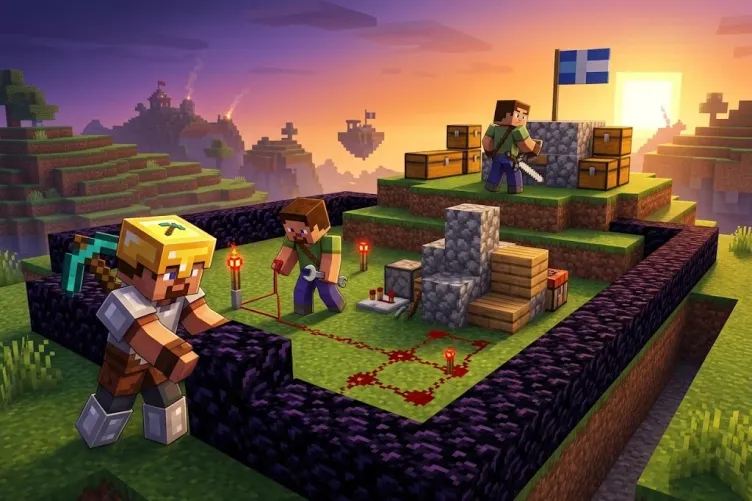
This is one of the most important and underestimated skills in Factions. A well-built base can withstand hours against experienced raiders. A poorly built base can fall in minutes.
The Basic Principles
- Thick walls: the thickness of your walls determines how long it takes to break through with TNT cannons. A 20-block thick obsidian wall is practically unbreakable on most servers.
- Alternating layers: alternate different materials to force raiders to adjust their cannons between each layer.
- The buffer: the buffer zone around your main base, claimed but not built, which forces raiders to cannon from far away.
- The treasure room: store your most valuable items in a room deeply buried with additional layers of protection.
Materials by Resistance Level
- Obsidian: the most resistant material to TNT. Ideal for critical inner layers.
- Stone and sandstone: less resistant but cheaper. Good for the outer layers of the buffer.
- Water and lava: extinguish TNT and slow down raids. Used in intermediate layers.
- Sand: falls under gravity when the block below is destroyed. Used to automatically fill breaches in certain defensive configurations.
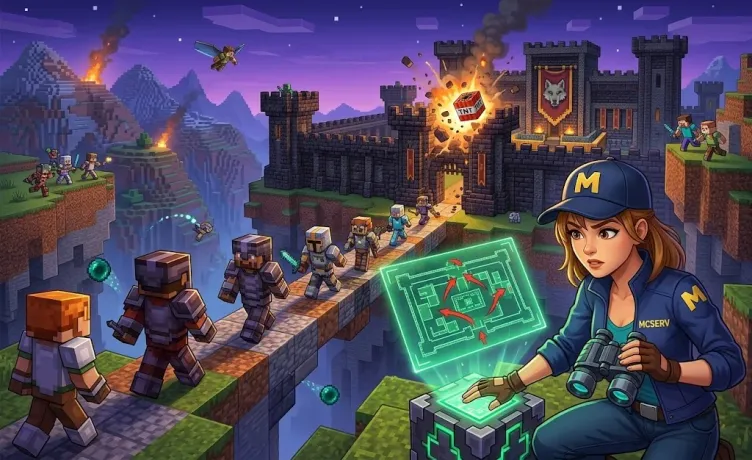
The Art of Raiding
Raiding a base is the most exciting and technical activity in Factions. It requires preparation, coordination, and an understanding of TNT mechanics.
Before the Raid: Reconnaissance
- Locate the base: identify the coordinates via informants, suspicious claims on the map, or by discreetly following a member of the target faction.
- Assess the defenses: observe the thickness of the walls, water and lava protections, and the presence of traps.
- Calculate the necessary resources: a serious raid may require hundreds of TNT and several hours. Prepare accordingly.
- Check the power: if their power is low, you can overclaim directly. If it is high, you need to cannon.
TNT Cannons: Basics
A TNT cannon is a Redstone construction that propels TNT blocks to break through enemy walls. Building cannons is a skill in itself in Factions.
The types of basic cannons:
- Linear cannon: shoots in a straight line, the simplest to build
- Hybrid cannon: combines multiple shooting directions to bypass defenses
- Roof cannon: shoots upwards to attack the ceiling of an underground base
- Anti-anti-nuke cannon: cannons designed to counter specific anti-cannon defenses
During the Raid: Coordination
- A player operates the cannon
- One or two players cover against defenders in PvP
- A player monitors the breach's progress
- A player ready to enter as soon as the breach is opened
Diplomacy: Alliances and Wars
Factions are not just about raw PvP. Politics between factions is often as important as combat mechanics.
Forming Alliances
An alliance allows two factions not to target each other and sometimes to share certain resources or information. The best alliances in Factions are based on clear common interests:
- Defense against a common enemy that is too powerful
- Sharing separate farming areas to avoid conflicts
- Coordination for a joint raid against an enemy faction
Declaring War
Some servers have a formal war declaration system. In this case, both factions can fight more freely with specific rules set by the server. Other servers allow free attacks without declaration.
👉 Diplomacy rules vary greatly between servers. Always read the server rules before attacking a faction that has not displayed hostility.
4-Week Progression Plan in Factions
- Week 1: join an established faction, learn the server's economy, farm resources, participate in defenses. Observe how more experienced members play.
- Week 2: start actively contributing to raids. Learn to operate a basic cannon. Develop your PvP skills in the Factions context (enchantment gear, potion management).
- Week 3: if you play with reliable friends, consider founding your own faction. Build your first defensive base and aim for your first successful raid.
- Week 4: optimize your economy (spawners, automatic farms), improve your defenses, and aim for the end-of-season ranking.
FAQ
What are Factions in Minecraft?
Factions is a competitive Minecraft game mode where players form teams, claim territories, build fortified bases, and engage in TNT raids and PvP. The goal is to become the dominant faction on the server by the end of the season.
How to join a faction in Minecraft?
The command is usually /f join [faction name] if it is open, or you can receive an invitation from a member via /f invite [your username]. Look for recruitment announcements in the server chat or on their Discord.
What is power in Minecraft Factions?
Power is an individual gauge that contributes to your faction's total pool. It determines how many chunks your faction can claim. Dying temporarily reduces your power. If your faction's total power drops below the number of claimed chunks, those chunks become vulnerable to overclaiming.
What is the best Factions server for beginners?
InsanityCraft and PikaNetwork are the most accessible for beginners. Join at the start of the season and join an existing faction rather than creating one alone. Find the best options on McServ.org.
Do Factions have resets?
Yes. The vast majority of Factions servers operate in seasons with regular resets (weekly, monthly, or on a fixed schedule). The reset starts from scratch for everyone, giving every player a fair chance at each new season.
➡️ Ready to join your first faction? Find the ideal server on McServ.org.